
East Herts plans to shut its housing register to new applicants who have not lived in the district for 12 months. The Executive considers it on 6 October.
East Herts is the only council in Hertfordshire that lets anyone join its housing register, wherever they live. That is about to change. New applicants would have to have lived in the district for the last 12 months, under a revised policy going to the council’s Executive on Tuesday 6 October.
The same report changes the income limit for joining the register and replaces the points system with four priority bands. It is the first substantial rewrite of the policy since it came into effect on 1 May 2013 (Executive report, Revised Housing Register and Allocations Policy).
Why the council wants a residency rule
East Herts owns no council homes. It nominates applicants to housing associations instead: 40 of them operate in the district, with more than 9,700 homes between them.
On 31 March 2026 there were 2,566 live applications on the register, up 251 (11%) in a year. Of those, 985 came from households that did not live in East Herts, 38% of the total. The report says 83% of them had no local connection through family or work either.
Those applicants were very unlikely to be housed. Only 4.9% of lettings in 2025/26 went to people with no connection to the district, and 70.8% of those were sheltered homes for older people. The council’s case is that an open register raises hopes it cannot meet.
The report also notes that every other Hertfordshire council already has a residency requirement, ranging from three to ten years. East Herts is proposing 12 months.
Who would still be able to apply
The 12-month rule would apply only to new applications. Existing applicants without a local connection would stay on the register in the lowest band, at their current priority.
The draft keeps the door open for several groups. According to the proposed changes, the residency rule would not apply to:
- people applying for sheltered or over-55s housing
- applicants whose parents, adult children or adult brothers or sisters live in East Herts and have done for the last five years
- people who have worked in East Herts continuously for 12 months
- care leavers referred by Hertfordshire County Council
- people fleeing domestic abuse
- households the council has accepted a homelessness duty to
- members of the armed forces or reserves, and bereaved partners of service personnel
- people who need to move to give or receive care from family in East Herts
The sheltered housing and family exceptions were added after consultation. Housing associations asked for the first. The second came from the council’s Overview and Scrutiny Committee and Citizens Advice (Appendix A, proposed changes).
The income limit: lower for singles, higher for families
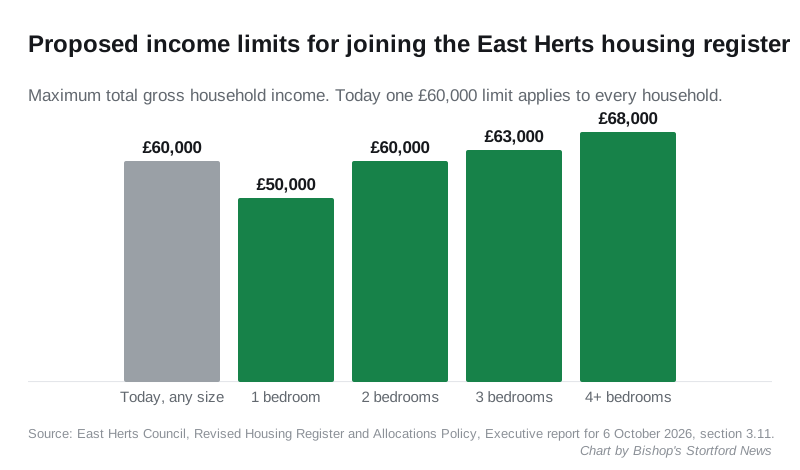
Today no household earning more than £60,000 a year can join the register, whatever its size. The report says this shuts out larger households with more than one adult working, because everyone’s income counts.
The new limits would depend on the size of home a household needs:
| Bedroom need | Income limit now | Proposed limit |
|---|---|---|
| 1 bedroom | £60,000 | £50,000 |
| 2 bedrooms | £60,000 | £60,000 |
| 3 bedrooms | £60,000 | £63,000 |
| 4 or more bedrooms | £60,000 | £68,000 |
The consultation draft had higher figures. Respondents said they were too high, and the council cut them. The savings limit of £16,000 stays as it is, and the thresholds would be reviewed every two years.
The report puts local rents for a three-bedroom home at between £1,657 and £2,181 a month.
From points to bands
Applicants are now ranked by points, including up to four “waiting points” for time on the register. Under the new policy each household would go into one of four bands:
- Band A: an exceptionally urgent need to move
- Band B: a high priority statutory housing need
- Band C: a statutory housing need
- Band D: lower priority, no statutory housing need
Within each band, whoever has been in it longest goes first. The council says this gives more weight to time spent in unsuitable housing than the current points do. It also says the published results will be easier to follow, because they will show the band and waiting time of each successful bidder.
Existing applicants were less keen. Across all 92 survey responses, 61.3% backed the switch to bands. Among the 19 respondents already on the register, only 36.8% did, and 57.9% disagreed. The report says officers will work with current applicants to reassure them that their relative position is unlikely to change.
The residency rule was far more popular: 89.2% of respondents agreed with it, and 78.9% of those already on the register.
Changing the council’s IT system would cost about £7,000.
What happens next
The Executive is being asked only to recommend the policy. The final decision belongs to full Council, which next meets on Wednesday 14 October and again on 9 December (East Herts Council meetings). The Executive meets at 7pm on 6 October in the Council Chamber at Wallfields, Hertford, and the meeting is webcast (agenda).
The report gives no start date for the new policy.
What it means for you
- Already on the register? You stay on it. The residency rule is for new applications only, and the council says your relative priority is unlikely to change when points become bands.
- Living outside East Herts and thinking of applying? Once the policy takes effect you will need 12 months’ residence, unless you are applying for sheltered housing or fall into one of the exempt groups above. Close family who have lived here for five years, or a year’s work in the district, would count.
- A single person or couple earning between £50,000 and £60,000? You can join today. Under the proposals you would no longer qualify for a one-bedroom home.
- A larger household earning just over £60,000? You may qualify for the first time, up to £63,000 for a three-bedroom need or £68,000 for four.
- Want a say? Contact your district councillor before 14 October, or watch the 6 October Executive on the council’s webcast.
For the council’s other housing figures, see our Bishop’s Stortford house prices page and council tax bands.
Have your say