
Thames Water's Stansted works spilled storm sewage into the Stort 28 times in 2025. Six overflows around Bishop's Stortford ranked; none had a fix logged.
The sewage works that spills most often straight into the River Stort near Bishop’s Stortford is Thames Water’s Stansted Mountfitchet works, about two miles upstream of the town. It released storm sewage into the river 28 times in 2025, for a total of 313 hours. That is 13 days and one hour.
The figures come from the Environment Agency’s official record of every storm overflow in England, the Event Duration Monitoring annual return. We went through it for every overflow that discharges into the Stort, or into the brooks that feed it, within about five miles of the town (Environment Agency, EDM storm overflow annual returns).
The river is back in the news because of a spill this month. Hertford and Stortford MP Josh Dean told a Westminster Hall debate on 14 September that “raw sewage was again discharged into the Stort navigation in a spill that lasted more than eight hours, leaving dead fish and visible pollution in its wake” (Hansard, Water Sector: Public Ownership, 14 September 2026). That spill happened in 2026, so it will not appear in the official figures until the 2026 return is published next spring.
Every overflow around the town, ranked
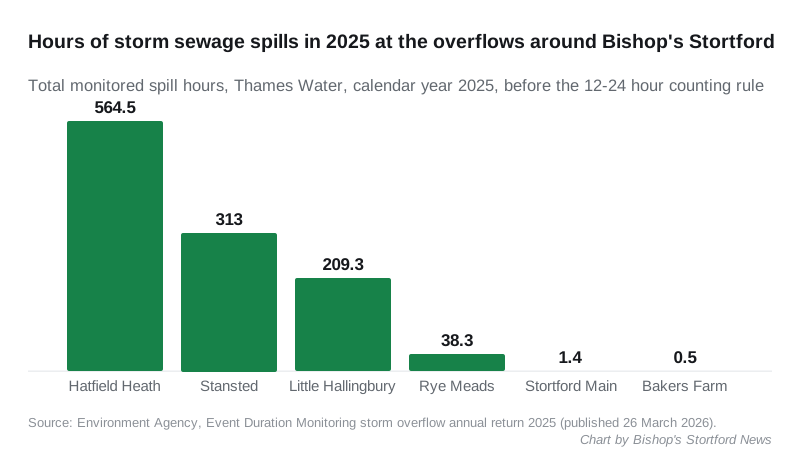
All six are run by Thames Water. Hours are the total time the monitor recorded sewage spilling during the year.
| Overflow | Where, from the town centre | Flows into | Spills 2025 | Hours 2025 | Spills 2024 | Long-term average spills |
|---|---|---|---|---|---|---|
| Hatfield Heath sewage works | About 5 miles south-east, Essex | Hatfield Heath watercourse, Pincey Brook catchment | 29 | 564.5 | 97 | 85.6 |
| Stansted Mountfitchet sewage works | About 2 miles north, Essex | River Stort | 28 | 313 | 64 | 29.3 |
| Little Hallingbury sewage works | About 2.5 miles south, Essex | Little Hallingbury Brook | 26 | 209.3 | 50 | 36 |
| Rye Meads sewage works | About 9 miles south-west | Toll House Stream, Stort to Lee | 5 | 38.3 | 26 | 21.6 |
| Bishop’s Stortford Main pumping station | About 1 mile south-east | Stort Navigation | 1 | 1.4 | 12 | 5.4 |
| Bakers Farm pumping station, High Wych | About 5 miles south-west | High Wych Ditch | 1 | 0.5 | 7 | 10.5 |
Two more overflows in the area recorded almost nothing. Birchanger’s Duck End overflow spilled no times in 2024 or 2025. Stansted Airport’s overflow into Pincey Brook spilled once in 2025, for 3 hours 52 minutes.
What the record says about each works
Stansted Mountfitchet. This is the only works in the table that discharges into the River Stort itself. Its 2025 total of 28 spills sat just below its long-term average of 29.3. In 2024 it spilled 64 times, for 922.75 hours, and Thames Water put that year down to “confirmed exceptional weather”. For the long-term pattern, the 2025 return gives a different reason: “hydraulic capacity”. In the Environment Agency’s framework, that means the sewers and tanks are not big enough to cope with normal rainfall on top of the sewage.
Hatfield Heath. This is the worst performer by a distance. It averages 85.6 spills a year, and it spilled 120 times in 2023 and 97 times in 2024. Even in dry 2025 it ran for 564.5 hours, the equivalent of 23 and a half days. The reason recorded is “asset configuration”, meaning the design of the pumps, pipes or storm tanks. The 2025 return lists no investigation and no improvement work at the site in the year.
Little Hallingbury. It spilled 26 times for 209.25 hours in 2025. The long-term reason given is surface water infiltration, which means rainwater and groundwater getting into the sewers.
Bishop’s Stortford Main pumping station. This is the only overflow in the return that discharges into the Stort Navigation in the town. It spilled once in 2025, for 1 hour 24 minutes, against 12 times and just over 101 hours in 2024.
Why 2025 looks so much better
Across the six overflows, spills fell from 256 in 2024 to 90 in 2025, a drop of 65%. Spill hours fell from about 3,877 to about 1,127, a drop of 71%.
That is steeper than the national picture. Across England, spills fell 35% and spill hours 48%, according to the Environment Agency’s statement on the 2025 figures. The agency said much of the improvement “reflects unusually dry conditions in 2025 following a particularly wet 2024”. Its chair, Alan Lovell, said the numbers were “heavily influenced by rainfall levels”.
So the fall is mostly the weather, not the works. The return backs that up:
- all six overflows have “no improvement action in reporting period” for 2025
- five of the six have an investigation under the Environment Act storm overflow programme listed as ongoing
- Hatfield Heath, the worst of them, has no investigation listed at all for 2025
What it means for you
- Swimming, paddling and dogs. None of the six overflows is recorded as affecting a designated bathing water, so nobody tests this stretch for swimmers. After heavy rain, assume the river may be carrying storm sewage.
- Check before you go. Thames Water publishes live alerts from its overflow monitors on its storm discharge map.
- Report pollution. If you see dead fish, discoloured water or sewage in the Stort, call the Environment Agency’s incident hotline on 0800 80 70 60. It is open 24 hours.
- Walking the towpath. The Stort Navigation runs from South Mill Lock down through Sawbridgeworth to the Lee. Our guide to things to do in Bishop’s Stortford covers the river walks.
How we did this
We downloaded the Environment Agency’s annual returns for 2023, 2024 and 2025 and selected every overflow whose outlet sits within about five miles of the town, plus Rye Meads, where the Stort meets the Lee. Distances are measured from the grid reference of each outlet to the town centre and rounded.
A few limits apply to these figures:
- The monitors record how long a spill lasted, not how much sewage was released or what was in it.
- Spill hours are the raw monitored time. The spill count uses the agency’s 12-to-24-hour counting rule, which groups a run of short spills into one.
- Every monitor in the table was working for at least 99% of 2025.
Have your say