
A year after the three-weekly bin switch, non-recyclable waste is down 36% and East Herts has caddied 6,500 tonnes of food waste. Defra's last full-year recycling rate for the district was 43.2%.
One year after East Herts moved every household onto weekly food waste collections and a three-weekly cycle for everything else, the council says the amount of non-recyclable rubbish put out across East and North Herts has fallen by 36%, around 14,370 tonnes, and that East Herts households alone have filled their brown caddies with more than 6,500 tonnes of food waste. (East Herts Council, 3 August 2026)
The council’s own headline for the release was “Bingate, one year on”, a nod to the reception the change got when it landed on 4 August 2025. Its partner North Herts Council, which shares the Veolia contract, put it more plainly in February: “some households initially expressed concerns around bin numbers and collection frequency”. (North Herts Council, 27 February 2026)
What neither council’s release says is where East Herts started from. The government’s own figures, published in March, show the district’s household recycling rate had slipped every year but one since 2019-20, from 50.1% to 43.2% in 2024-25, the last full year before the change. That is the number the new bins have to move, and the target its own service page names is 60%. (Defra, local authority collected waste, annual results 2024-25; East Herts Council, bin collection service)
The year-one figures, as the councils report them
All of these compare August 2025 to July 2026 with August 2024 to July 2025, and unless stated they cover East and North Herts together, because the two councils run one contract and published one set of numbers. (East Herts Council, 3 August 2026)
- Non-recyclable waste down 36%, roughly 14,370 tonnes less than the year before, across the two districts.
- Food waste: more than 6,500 tonnes collected in East Herts in the first year. East Herts had no separate food collection before August 2025, so all of that is material that previously went in the rubbish. By the end of December the running total was 2,717 tonnes, so the rate of collection has held up through the second half of the year rather than fading. North Herts, which already had a food service, collected an extra 570 tonnes, taking its year to 5,000 tonnes. (North Herts Council, 27 February 2026)
- Paper and cardboard recycling up 19%, more than 1,950 additional tonnes, which the councils put down to the larger blue-lidded wheelie bin that replaced the open boxes.
- Plastic bags and wrapping: 325 tonnes collected at the kerbside across the two districts, a material that could not go in the recycling at all before.
- Around 31,000 households now subscribe to the two councils’ bin-day apps, launched in November 2025.
The 36% figure is large, and it is worth being clear about what it is. It is a tonnage change reported by the councils and their contractor, not the official recycling rate, which is calculated by Defra on a financial-year basis and published about a year in arrears. East Herts’ first year under the new service, 2025-26, will not appear in the national tables until 2027. In 2024-25 the district collected 28,683 tonnes of household rubbish from the kerbside that was not recycled, so a fall of the order the councils describe would be a very large change in that number. (Defra, Table 1, 2024-25)
Where East Herts started: 43.2%, and falling
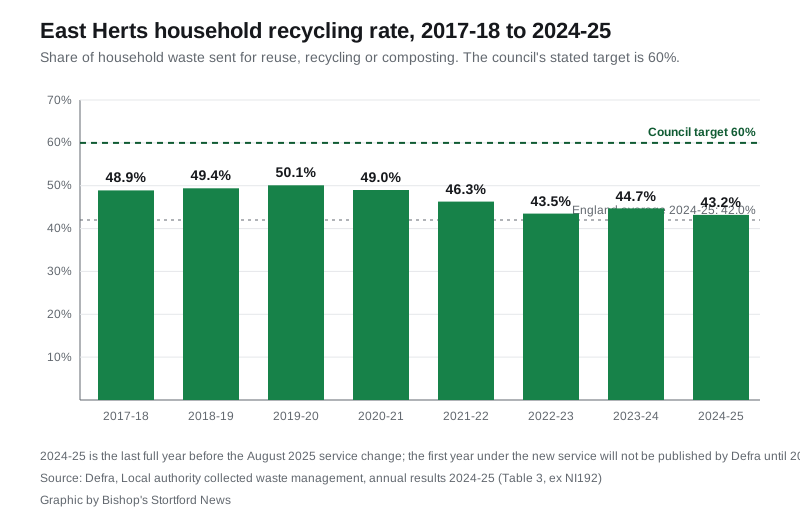
Defra’s Table 3 gives the share of household waste each council sends for reuse, recycling or composting. For East Hertfordshire District Council it reads 48.9% in 2017-18, 49.4% in 2018-19, 50.1% in 2019-20, 49.0% in 2020-21, 46.3% in 2021-22, 43.5% in 2022-23, 44.7% in 2023-24 and 43.2% in 2024-25. Over the same period the amount of non-recycled household waste per household rose from 425.6kg in 2019-20 to 452.9kg in 2024-25. (Defra, Table 3, 2024-25)
That 43.2% is a shade above the England average of 42.0% but below the Eastern region’s 44.9%, and a long way behind North Herts, whose 56.5% in 2024-25 reflects a food waste service it already had. Broxbourne, which covers Hoddesdon, Cheshunt and Waltham Cross and runs a separate collection service, recorded 42.5%. Hertfordshire County Council, which handles disposal for all ten districts, reported 51.7% for the county as a whole and sent just 0.3% of its waste to landfill. (Defra, Table 3, 2024-25)
So the district was drifting the wrong way for five years before the change, and the food caddy is the single biggest lever it had left: food is heavy, it was all going in the purple bin, and every tonne moved to the caddy counts towards the recycling rate. The 6,500-tonne figure is why the councils are confident the rate will jump; how far, and whether it gets near 60%, is a question for the 2025-26 tables.
What actually changed on 4 August 2025
For anyone who has moved to the district since, or has still not settled into the rota, the service that started a year ago works like this. (East Herts Council, bin collection service)
- Food waste: 23-litre brown outdoor caddy (with a 5-litre kitchen caddy), collected every week. Cooked and raw food, bones, plate scrapings, tea bags and peelings all go in.
- Mixed recycling: 240-litre black-lidded bin, every three weeks. Plastic, glass, tins, cans and cartons, and now plastic bags and wrapping too. Do not bag it up.
- Cardboard and paper: 240-litre blue-lidded bin, every three weeks, replacing the old open boxes.
- Non-recyclable waste: 180-litre purple-lidded bin, every three weeks.
- Garden waste: 240-litre brown-lidded bin, fortnightly, paid subscription only.
- Flats and homes with communal bin stores stayed on a two-weekly cycle.
- Bins need to be at the front boundary by 6.30am, lids closed.
The council says the changes were agreed after a public consultation in summer 2022, confirmed by its Executive in October 2022, revised in December 2023 and finalised in July 2024, and were designed to meet new government requirements for separate food and paper collections as well as the 60% target. Veolia took over the East and North Herts contract in May 2025, ahead of the August switch. (East Herts Council, bin collection service; East Herts Council, Veolia starts collections)
Councillor Tim Hoskin, East Herts’ Executive Member for Environmental Sustainability, said in the anniversary release: “I am especially pleased to see how quickly East Herts residents have adapted to separate food waste collections. Food waste is such a valuable resource when processed properly, creating biogas and biofertiliser, so it really isn’t ‘waste’ at all.” Ilana Shaw, Veolia’s Divisional Head of Municipal Operations, said crews were “able to collect significantly more recycling than before”. (East Herts Council, 3 August 2026)
What it means for you
- The rota is not changing. Nothing in the anniversary release alters collection days or frequency. If the three-weekly purple bin still overflows, the council’s advice is that the food caddy and the two recycling bins should be taking most of what used to go in it; a household that fills the purple bin every three weeks is putting recyclables in it, or can request a bigger bin if it qualifies.
- The 31,000 app subscribers get the bank holiday changes pushed to them. The next one is Monday 31 August; check your day on the council’s find my collection day page or the Your East Herts app rather than assuming.
- The 60% figure is a government target, not a local ambition. The council’s own service page lists it, alongside the legal requirement to collect food and paper separately, as the reason the service changed; the year-one tonnages are the first evidence of whether the redesign can close a 17-point gap.
- Hoddesdon, Cheshunt and Waltham Cross readers are on a different service. Broxbourne Borough Council collects there, and none of the East Herts figures above apply. Broxbourne’s own 2024-25 recycling rate was 42.5%.
- The real test lands next spring. Defra’s 2025-26 tables, due around March 2027 on the same publication schedule as this year’s, will give the first official recycling rate for the new service. We will report it against the 43.2% baseline the day it appears.
Have your say