
East Herts recorded 1,930 unemployment-related claims in July, up 7.8% in a year, the steepest rise of the county's ten districts. Waltham Cross ward is on 5.1%.
East Hertfordshire has seen the sharpest rise in unemployment-related benefit claims of any district in the county over the past year.
There were 1,930 claimants in the district in July, up 140 on the 1,790 recorded a year earlier. That is a rise of 7.8%, the steepest of Hertfordshire’s ten districts and the tenth steepest of the 45 local authority areas in the East of England. The figures were published by the Office for National Statistics on 18 August. (ONS claimant count by sex and age, via nomis)
The district is still one of the easiest places in England to find work. Claimants make up 2.0% of East Herts residents aged 16 to 64, against 4.0% across England. But the direction has changed: the count has risen in each of the last three months, from 1,850 in May to 1,885 in June and 1,930 in July.
It is not young people driving it here
The obvious explanation for a rising claimant count in 2026 has been the youth labour market. That is not what happened in East Herts.
| Age group | July 2025 | July 2026 | Change |
|---|---|---|---|
| 18 to 24 | 240 | 260 | +20 (+8.3%) |
| 25 to 49 | 1,060 | 1,140 | +80 (+7.5%) |
| 50 and over | 485 | 530 | +45 (+9.3%) |
The district’s under-25 rise was the third smallest in Hertfordshire, and roughly in line with England’s 9.4% increase. More than half of the extra claimants were aged 25 to 49, and the steepest rise in percentage terms was among people aged 50 and over.
Broxbourne is the opposite story
Across the other half of this paper’s patch the totals barely moved but the age profile did.
Broxbourne recorded 2,165 claimants in July, up 3.8% on the year, a rate of 3.4%. Within that, claims from people aged 18 to 24 rose from 330 to 405, an increase of 22.7%. That is more than double the England figure and the second steepest in Hertfordshire, behind St Albans on 23.8%.
Broxbourne now has 405 young claimants against East Herts’ 260, despite having around two thirds of its population.
The ward gap is the real headline
District averages hide a great deal. Of the 36 wards across the two districts, Waltham Cross has the highest rate at 5.1%, with 420 claimants, more than any other single ward in either district. Ware St Mary’s has the lowest at 1.1%.
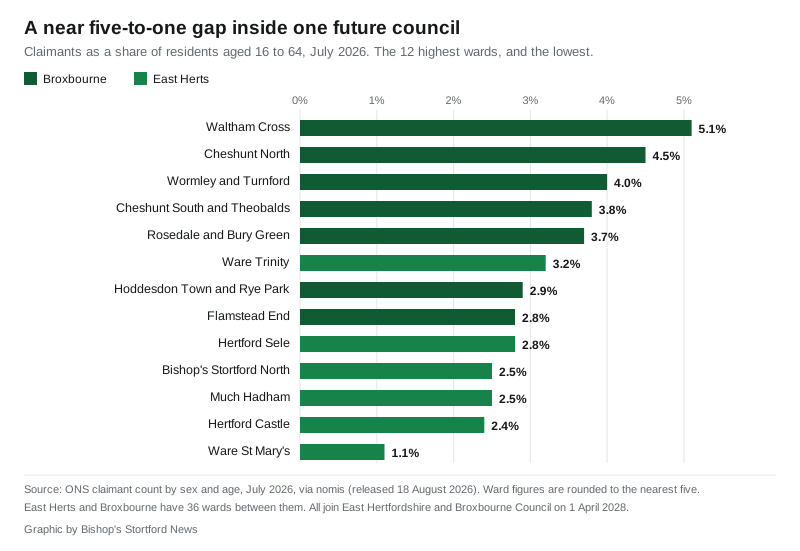
Five of the six highest wards are in Broxbourne, all of them in the Waltham Cross and Cheshunt corridor. In Bishop’s Stortford the highest is Bishop’s Stortford North at 2.5%, followed by Bishop’s Stortford Central at 2.3%, Bishop’s Stortford Parsonage at 2.1% and Bishop’s Stortford All Saints at 2.0%. Bishop’s Stortford South is on 1.5% and Thorley Manor on 1.6%.
Hertford Sele (2.8%) and Ware Trinity (3.2%) both sit above every Bishop’s Stortford ward.
Why this could matter more later
Every one of those 36 wards was to be inside the same council by April 2028. East Herts and Broxbourne were to be merged into East Hertfordshire and Broxbourne Council with 75 councillors. Update, 9 September 2026: the government paused that decision on 7 September and no new date has been published (East Herts merger paused).
That authority will be setting one employment, skills and welfare-support approach for a patch containing both Waltham Cross at 5.1% and Ware St Mary’s at 1.1%.
What it means for you
The claimant count is not the unemployment rate. ONS describes it as an official statistic in development measuring people receiving a benefit principally because they are unemployed: those on Jobseeker’s Allowance, plus Universal Credit claimants in the “searching for work” group. Some people in low-paid work are counted; some people looking for work are not. (ONS, Labour market overview, UK: August 2026)
The figures move after publication. These are provisional and revised each month, so a number quoted a few weeks ago may no longer be the current one. Ward counts are rounded to the nearest five, which is why the wards do not sum exactly to the district total.
If you are the one claiming, the searching-for-work conditionality group is the part of Universal Credit with the strictest job-hunting requirements, and the rules on what you must do are set out on gov.uk.
The next release is 15 September, covering August. We will update this page then.
For the other side of the local economy, our East Herts house prices report tracks what homes across the district are selling for.
Have your say