
The council replacing East Herts and Broxbourne has a legal name, 75 seats and a May 2027 election. Neither council says so; the government's letters do.
Update, 9 September 2026: this has been paused. The government put the Hertfordshire reorganisation decision under review on 7 September 2026, and the May 2027 elections to the shadow authorities described below will not take place. East Herts District Council will hold its own election on the usual cycle instead. Everything below records what was decided in July, and none of it has been withdrawn, but no part of the timetable can now be relied on. See East Herts merger paused.
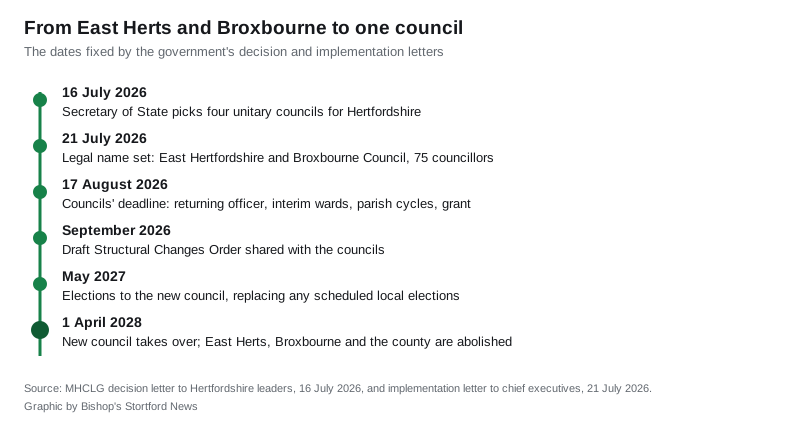
The council that will replace East Herts District Council and Broxbourne Borough Council in 2028 has a legal name. It is East Hertfordshire and Broxbourne Council, it will have 75 councillors, and the people who will sit on it are due to be elected in May 2027.
None of that is on either council’s website. It is set out in a letter sent to Hertfordshire’s chief executives on 21 July by Ruth Miller, co-deputy director for local government reorganisation at the Ministry of Housing, Communities and Local Government. (Implementation letter to Hertfordshire chief executives, 21 July 2026)
That letter, and the Secretary of State’s decision letter of 16 July, are the record. Between them they settle:
- the four new councils’ legal names and how many councillors each gets
- which wards move between them, and the one that was refused
- that May 2027’s scheduled local elections are replaced by elections to the new councils
- that the existing councils are abolished on 1 April 2028
- £900,000 per new council to pay for the changeover
What the new council covers
East Hertfordshire and Broxbourne Council takes in the whole of the current East Herts and Broxbourne areas, which is most of this paper’s patch: Bishop’s Stortford, Sawbridgeworth, Hertford, Ware, Buntingford, Hoddesdon, Cheshunt, Waltham Cross and Broxbourne itself.
It also gains six wards from elsewhere in the county:
- Northaw and Cuffley, from Welwyn Hatfield Borough Council
- Royston Heath, Royston Palace, Royston Meridian, Ermine and Weston and Sandon, from North Hertfordshire District Council
One ward that the proposing councils asked for was refused. The Secretary of State ruled that Arbury, population 2,880, should stay in the Central council because of its links to Baldock and the A1 corridor. He said he was convinced by the representations on the point, including from North Herts itself. (Decision letter to Hertfordshire leaders, 16 July 2026)
It will be the smallest of the four
The government has set the councillor numbers, and ours is the lowest:
| New council | Replaces | Councillors |
|---|---|---|
| Central Hertfordshire Council | North Herts (less five wards), Stevenage, Welwyn Hatfield (less one ward) | 89 |
| West Hertfordshire Council | Dacorum, St Albans | 84 |
| South West Hertfordshire Council | Hertsmere, Three Rivers, Watford | 79 |
| East Hertfordshire and Broxbourne Council | East Herts, Broxbourne, plus six wards | 75 |
On population it is the smallest too. The latest ONS estimates put East Herts at 158,033 people and Broxbourne at 103,130 in mid-2025, a combined 261,163 before the incoming wards are added. (ONS mid-year population estimates via nomis)
East Herts leader Councillor Ben Crystall made the same point in July, calling it “the smallest unitary council in Hertfordshire” and saying it would be “essential that it has all the resources it needs to deliver high quality local services”. (East Herts Council, 16 July 2026)
All four are below the 500,000 population figure the government normally uses. The Secretary of State addressed that directly: it “has always been a guiding principle, not a fixed threshold”.
The name your council is still using is not the legal one
Both East Herts and Broxbourne announced the decision on 16 July under the name “Eastern Hertfordshire”. The implementation letter, sent five days later, rules that name out. It says it is “not possible to use the -ern suffix (e.g. Eastern Hertfordshire) or to include dashes in council names”, and that the word “City” cannot appear either, because city status is granted by the monarch.
Councils can adopt a different trading name once they exist, or change their legal name by a two-thirds vote of the council under section 74 of the Local Government Act 1972. Neither has happened. As things stand the legal name is East Hertfordshire and Broxbourne Council.
East Herts’ standing information page on the subject, “The Future of Local Government”, has not been updated either. Its timeline still ends with “February 2026: Government launches consultation on unitary proposals”, then jumps to the 2027 elections. The July decision does not appear on it. (East Herts Council, The Future of Local Government)
A deadline passed last week with nothing published
The 21 July letter gave the councils until 17 August to send four things back to the ministry:
- which council’s head of paid service should be the returning officer for the new council’s first election
- proposed interim ward boundaries for that election, in a table, with councillor numbers per ward
- the current election cycles of every parish council in the area, and how they should be aligned
- which council should receive the £900,000 transition grant
Those decisions shape who you vote for and in which ward. The deadline has passed. As of today neither East Herts nor Broxbourne has published what it submitted, and neither has held a meeting on it: East Herts’ only August committee was the Development Management Committee on 12 August, and the county’s dedicated reorganisation website has published nothing since 16 July.
What the public actually said
The government’s own analysis of the statutory consultation, published on 22 July, records 1,831 responses. Among individuals living in Hertfordshire, the chosen four-unitary model drew 31% positive and 54% negative responses. The two-unitary model they did not choose drew 38% positive and 50% negative.
Only the named consultees, meaning councils and public bodies, preferred the winner, at 50% positive and 22% negative. Organisations rated it 32% positive and 52% negative. (Summary and analysis of consultation responses, 22 July 2026)
The money
Each new council gets £900,000 towards transition costs, £3.6m across Hertfordshire, paid as a section 31 grant during 2026/27. The letter says it should go on service disaggregation, data and cyber work, programme management, equipment for new councillors and early preparation for children’s services and adult social care.
A further £150,000 per new council is available for leadership capacity in children’s services, adult social care and public health, out of a national £63m capacity fund.
What happens next
- September 2026: the ministry expects to share a draft Structural Changes Order with the councils
- 2027: the Order is laid before Parliament, debated in both Houses and, if approved, comes into force
- May 2027: elections to all four new councils, replacing any scheduled local elections. Sitting councillors have their terms extended to that date
- 2027 to 2028: the elected members sit as a “shadow” council, setting the first budget and plans
- 1 April 2028: the new councils take over, and East Herts, Broxbourne and Hertfordshire County Council are abolished
A joint committee will run the preparation for each new council. Ours gets twelve members: six county councillors, four from East Herts and Broxbourne, and one each for the two boundary-change areas. The single implementation team for the whole county will be led by Hertfordshire County Council’s head of paid service.
What it means for you
Your bin collections, council tax bill and planning applications do not change before April 2028. East Herts and Broxbourne remain responsible for their services until the day they are abolished, and the Order will place a duty on them to co-operate in the meantime.
Your vote changes sooner. If your council was due to hold elections in May 2027, that poll is replaced by an election to the new unitary council. The ward you vote in may not be the one you vote in now, because interim ward boundaries were among the things submitted on 17 August. The Local Government Boundary Commission for England will run full electoral reviews afterwards.
Big spending decisions get a second lock. Once the Order is in force the government expects to issue a direction under section 24 of the Local Government and Public Involvement in Health Act, requiring the existing councils to get the shadow council’s consent before signing certain contracts or selling certain assets.
One council will run services on both sides of a line that has always divided them. From 2028 the same authority will collect the bins in Bishop’s Stortford and in Waltham Cross, run one planning service across both, and set one council tax. Until then, planning applications in Bishop’s Stortford are still decided by East Herts, and those in Hoddesdon, Cheshunt and Waltham Cross by Broxbourne.
We will update this page when the draft Order and the interim warding proposals are published.
Have your say