

East Herts asks the Secretary of State for arrest powers over breached stop notices and a presumption against retrospective permission. Council votes 14 Oct.
East Herts Council has asked the Government to change planning law after Sheering Mill Lane, and one of its six requests is a power of arrest. The council wants it to be a criminal matter to carry on building once a temporary stop notice or a court injunction has been served.
The request is in a letter from the council leader, Cllr Ben Crystall, to the Secretary of State for Housing, Communities and Local Government, Angela Rayner. It is dated 30 September and the council published it on 2 October (letter to the Secretary of State, 30 September 2026; council statement, 2 October 2026).
On Wednesday 14 October, full Council will also be asked to put on record how the Chief Executive, Helen Standen, authorised the High Court action over the August bank holiday weekend. The report for that meeting is the fullest account yet of what happened on the land, hour by hour (Emergency Action taken by the Chief Executive, Council, 14 October 2026).
This paper’s earlier reports are Sheering Mill Lane: site cleared, hearing 15 September and Sheering Mill Lane injunction stays, trial listed for 2027.
The six changes the council wants
The letter says the problem is not that deliberate unauthorised development is overlooked. The new National Planning Policy Framework already tells decision-makers to give “significant weight” to the harm it causes. The problem, the council says, is that a retrospective application can still be made, and still be granted, where other planning matters are judged to outweigh that harm.
It asks the Government to consider:
- A statutory presumption against retrospective permission. Where development was deliberately carried out without permission, the starting point should be that permission is not granted afterwards.
- Stronger early intervention powers. More flexible temporary stop notices, and “additional criminal sanctions” where a stop notice or an injunction is deliberately breached. The letter says this “should include consideration of powers of arrest”, and that Hertfordshire Constabulary supports it.
- A fast-track enforcement and appeal process for serious cases, with clear timescales for deciding retrospective applications once enforcement has begun.
- A review of how the Planning Inspectorate handles retrospective Gypsy and Traveller applications. The letter says inspectors routinely leave matters such as drainage, access and layout to planning conditions, which the council then has to resolve. At Chapel Lane, Little Hadham, it says, drainage “remains unresolved seven years after the appeal decision”.
- Easier access to injunctions, with a review of the cost and evidence barriers councils face, and a power of arrest attached where justified.
- Stronger powers against repeated breaches where enforcement or an injunction has already been needed once.
The letter also says the council “is committed to providing authorised sites through the proper planning process”, and that an unmet need for Gypsy and Traveller accommodation should not stop a council acting against deliberate breaches.
It names four East Herts cases since 2019: Chapel Lane, Little Hadham; Cherry Green Lane, Westmill; Mentley Lane, Puckeridge; and Sheering Mill Lane. It says the council supports a separate letter sent to the Secretary of State on 1 September by the Police and Crime Commissioner for Hertfordshire, Jonathan Ash-Edwards. The council has not published that letter, and we could not read the commissioner’s website today to check whether he has.
What the Prime Minister said
The Hertford and Stortford MP, Josh Dean, raised the site in the Commons on 1 September. He said “a treasured green space in Sawbridgeworth was decimated by building work without planning permission”, and asked the Prime Minister to meet him “to discuss why we need to change the law”.
The Prime Minister replied: “I absolutely will look out for my hon. Friend to discuss this further. We can do more to empower local authorities.” He said councils “do not have the enforcement capability that they once had” (Hansard, 1 September 2026).
Neither Hansard nor the council’s letter records a meeting having taken place.
The weekend, hour by hour
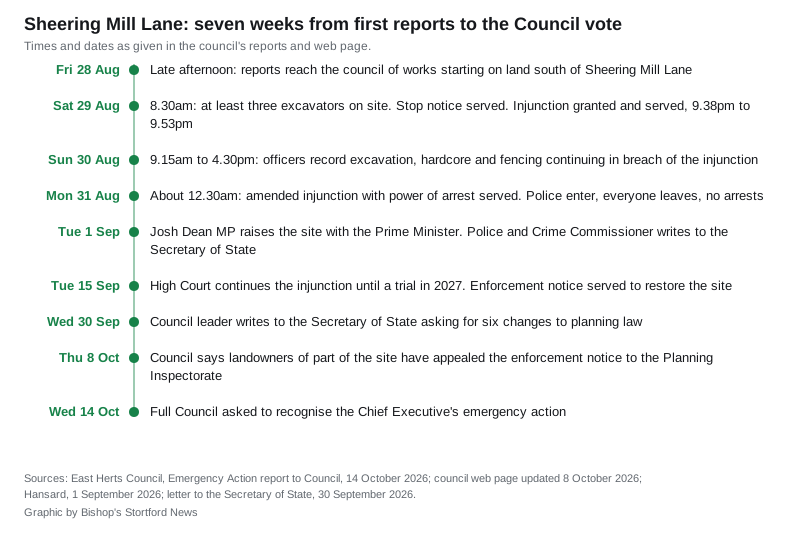
The Council report gives this sequence:
- Friday 28 August, late afternoon. The council receives reports of works starting on undeveloped land south of Sheering Mill Lane, on the western bank of the River Stort. The report says a temporary stop notice was issued that day. The council’s own web page says it was served “shortly after 10.45am on Saturday 29 August”. The two documents do not agree on the day.
- Saturday 29 August, 8.30am. At least three large excavators and other heavy machinery are working. Vegetation is being removed, the ground scraped and levelled, hardcore tipped and compacted, timber and aggregates stored, and holes dug for fence footings. People on the site tell an enforcement officer that “as the council had only issued a Temporary Stop Notice rather than an injunction, they would continue with their works”.
- Saturday 29 August, evening. The Chief Executive authorises an application to the High Court. An interim injunction under section 187B of the Town and Country Planning Act is granted and served by a planning enforcement officer between 9.38pm and 9.53pm. The web page puts the service at around 10.30pm.
- Sunday 30 August, 9.15am to 4.30pm. Three officers record continuous excavation, hardcore spreading and fencing, a second caravan, injunction notices being removed, and what the report calls “serious verbal abuse”.
- Monday 31 August, about 12.30am. An amended injunction with a power of arrest is served. Police enter the site. Everyone leaves. No arrests.
The judge, the report says, took account of “risk of harm both to residents’ homes and in terms of serious abuse, whether physical or verbal”, and of the movement of heavy machinery, in adding the power of arrest.
Why the Chief Executive acted alone
The council’s constitution lets senior officers apply to a court, but “with reference to the Shared Corporate Legal Service Manager”. She was not available over the bank holiday weekend. The Chief Executive instead used a separate power to “take any action, including the incurring of expenditure” where emergency action is required.
Before doing so, the report says, she took advice from Hertfordshire County Council’s Assistant Chief Legal Officer, who used to work for East Herts, and confirmed in writing that she was acting under the emergency power so that an audit trail existed. The Leader was kept informed throughout.
The report is careful to say this was not a “case of urgency” in the constitution’s sense, which would have meant an officer taking a decision normally reserved for councillors. Legal action is already delegated to officers. Emergency actions do not have to be reported to councillors at all; the Chief Executive and the Monitoring Officer chose to do so because it “aids transparency” and “supports the council’s efforts to argue for national policy changes”.
On cost, the report says only that staff call-outs and legal action “can be met from contingencies”. It gives no figure.
Where the site stands now
- The injunction runs until a trial in 2027, with the power of arrest still attached, after the High Court hearing on 15 September.
- An enforcement notice requires the land to be restored. The owner of part of the site was given access from Monday 21 September to begin that work.
- The owners of the other part have appealed the enforcement notice to the Planning Inspectorate, the council said in an update on 8 October (East Herts Council, page updated 8 October at 10:00). The council has not published the appeal reference or the grounds. While an enforcement appeal is undecided, the notice does not take effect on that land, so restoration of that part now waits on an inspector.
What it means for you
- Nothing in the law has changed. The letter is a request. Any of the six changes would need legislation or new guidance from the Government, and no timetable has been given.
- Wednesday’s meeting is at 7pm in the Council Chamber at Wallfields, Pegs Lane, Hertford, and is webcast. The Sheering Mill Lane report is item 11. Public questions are item 7 (agenda, Council, 14 October 2026).
- If you see activity on the land, the council’s standing advice is to call the police on 101. The injunction, with its power of arrest, is still in force.
- If you want to follow the enforcement appeal, it will be decided by the Planning Inspectorate, not the council. Our planning news page explains how applications and appeals in the district can be tracked.
Sources
- Letter to the Secretary of State, Intentional Unauthorised Development, 30 September 2026, East Herts Council
- Council statement, 2 October 2026, East Herts Council
- Emergency Action taken by the Chief Executive in Response to Unauthorised Development at Sawbridgeworth, report to Council, 14 October 2026
- Unauthorised works, land off Sheering Mill Lane, Sawbridgeworth, East Herts Council, page updated 8 October 2026
- Hansard, Commons, 1 September 2026, Josh Dean and the Prime Minister
Have your say